
Academic Policies
Academic Policies
NICC's academic progress policies establish specific standards that must be met by all students enrolled for credit at the College. In order to demonstrate Satisfactory Academic Progress (SAP) students must maintain a cumulative 2.00 GPA (grade point average) and 67% successful course completion rate. Students not meeting minimum standards will be subject to one or more of the following:
Warning
If a student has failed to maintain SAP, student must meet with both their faculty and student support advisor every two weeks. Students are allowed to register up to full-time status. If a student successfully completes this period, student returns to satisfactory progress. If a student status is unsatisfactory after the Warning, student will move to Suspension (See below).
Suspension
If a student does not attain satisfactory progress upon completion of the Warning semester, the student is considered to be making UNSATISFACTORY PROGRESS, and will be placed on suspension, which entails that the student meet with both their faculty and student support advisor every week and can enroll in ONLY one course. A student on suspension is ineligible to receive Federal Financial Aid and must utilize his/her own resources to pay student costs.
Application for Academic Plan (for Financial Aid or Unsatisfactory Progress)
All students have the right to appeal financial aid decisions. Appeals must be made in writing to the Financial Aid Director. Students must indicate in writing the reasons why minimum academic requirements were not achieved and reasons why financial aid should not be terminated. Documentation supporting the reason for unsuccessful completion is helpful in this review process. The Financial Aid Director will forward and present the appeal to the Student Scholastic Committee for consideration. The student and the student's advisor will be notified of the appeal outcome. Students on financial aid appeal are required to meet with their advisor once every two weeks for the entire semester for which they are under appeal. If the Appeal is approved the student will be placed on Academic Probation for one term when their Academic Record will be reviewed again for continuance or Suspension.
Probation
If a student has made UNSATISFACTORY PROGRESS, and has been placed on Suspension, then they must apply for an Unsatisfactory Progress Appeal to receive time to attempt to regain Satisfactory Progress. Types of appeals that will be considered for probation are illness/health, death in family, or major life interruption. For an appeal to be verified for a term that a student is enrolled the Appeal must be received by the end of the third week. If the Appeal is approved by the Student Scholastic Committee, the student must meet with both their faculty and student support advisor every week and if available/applicable, attend tutoring sessions. Scholastic Committee will determine how many credits the student will be eligible to enroll for while on probation. The committee will consider CGPA, completion percentage, attendance, and other factors. It will be documented in the student’s academic plan. If the student successfully completes this period, but does not meet SAP, they will continue Probation until the CGPA and the completion ratio are met. If the student status is unsatisfactory after the Probation status, the student’s status is classified as Suspension. If you are denied eligibility for probation, please follow the grievance process.
Academic Plan
If a student is approved for Probation, an Academic plan with expected course completion and advising needs will be filed with the Financial Aid office and the student's’ permanent record. An Academic plan is completed by the student and their Faculty Advisor. Plans must be on file for students requiring more than one term to regain eligibility and for students that are over 150% Lifetime Eligibility. The Academic plan must be reviewed each term. Students that are unable to successfully follow their Academic plan will need to appeal for a changed plan, following the Student Appeals Process.
Regaining Eligibility
A student placed on Academic or Financial Aid Suspension for not meeting minimum standards of satisfactory academic progress (SAP), cumulative grade point average (CGPA) and completion ratio, will be required to appeal the suspension. The appeals will be reviewed by the Scholastic Committee. The Scholastic Committee will make decisions on the appeal and the Financial Aid Advisor will keep minutes from these meetings for documentation. The Financial Aid Advisor will mail a letter to the student regarding appeal status and keep a copy of this letter in the student records and financial aid files. All students approved for probation will be required to have an academic plan and maintain progress with that plan. The academic plan will be negotiated based on the student’s personal time needs and courses needed by rotation schedule. All plans must be approved by the Department Chair, Retention Advisor, and Financial Aid Advisor and filed in the student’s permanent student record and financial aid files.
Students appeals will be considered in these four variations:
- Suspension due to the 150% rule – these will be approved for Academic so that the student can finish a degree program. Students will not be eligible for Title IV funding if they are at the 150% completion rule. They will be considered for scholarships that do not have Title IV eligibility requirements.
- Suspension due to a completion ratio that is not meeting 67% but who has a CGPA of 2.0 or higher will be considered for approval in a priority status.
- Suspension due to CGPA not meeting the institutional requirement based on attempted credit hours. Students with more than one term of insufficient points will be negotiated based on the student’s documentation of the cause of low grades. All students will be required to succeed one term on suspension that do not have adequate documentation of failed term causes.
- Suspension due to CGPA and not making the 67% completion ratio will be reviewed based on the student’s documentation of unsuccessful terms.
If the student is unable to make SAP within one term, they will be reviewed based on the successful tracking of their academic plan. A student who fails to make progress on their academic plan will be returned to suspension status. Additional appeals may be submitted to the committee, but the committee will always recognize the fact that the student had received prior opportunity to progress on an academic plan. Academic plans will be enforced until a student regains good standing or completes their degree program.
Students who register but who do not attend within the first three weeks of the first-class meeting will be given an “UW” (Unofficial Withdrawal) grade for the course or courses and could be disqualified from receiving any financial aid assistance for the semester. Additionally, students who exhibit excessive absenteeism will be subject to unofficial withdrawal (UW) at the discretion of the instructor. Being absent for one-fifth of the total class time is considered excessive absences.
It is the student's responsibility to contact their instructor if the student will be absent from class. Students who have situations that will require extended absences must meet with their instructor(s) or the Dean of Assessment & Curriculum.
Nebraska Indian Community College will allow enrolled members of the Armed Forces, including reserve components and National Guard to be readmitted if such members are temporarily unavailable or must suspend enrollment by reason of serving in the Armed Forces. Nebraska Indian Community College will offer Armed Forces members an incomplete following the incomplete grade policy for short absence accommodation. Long term absences will be allowed a withdrawal with note to ratio of completion in financial aid communications for students that are being called away for long term service. NICC will never inhibit an Armed Forces student from enrolling later after a short term or long-term absence after their service obligations.
After final grades have been filed with the Registrar’s Office, the instructor may change a grade. Circumstances that might necessitate changing of a grade include:
- clerical error made by the institution;
- changing a grade of "incomplete" that has been converted to an “F”;
- mutual agreement between the student and instructor over the subsequent semester.
Grade changes made for any reason must be made on the student information system by the instructor and approved by the Dean of Assessment & Curriculum and Registrar. Instructors have until the end of the following semester to request a change of grade. Students must appeal a grade by midterm of the following semester.
Students who want to change their schedule must officially drop or add courses electronically with their Student Services Advisor after they have consulted with their Faculty Advisor. The official drop and add period extends through the last day of the second week of each semester. After this period, students' schedules are official and students may not add courses to their schedules. Students electing to withdraw from a class or classes should refer to the "WITHDRAWAL" section of this catalog for more information.
|
Classification |
Definition |
GPA Requirement |
|
Freshman |
A student who has successfully completed 0 to 15 credits |
GPA Required 1.5 |
|
Freshman 2 |
A student who has successfully completed 16 to 30 credits |
GPA required 1.75 |
|
Sophomore |
A student who has successfully completed 31 or more credits toward graduation |
GPA required 2.0 |
|
Junior |
A student who has successfully completed 61 to 90 credits toward graduation in a bachelor degree program |
GPA required 2.0 |
|
Senior |
A student who has successfully completed 91 or more credits toward graduation in a bachelor degree program |
GPA required 2.0 |
|
Non-degree Student |
A student who is not seeking a degree (FSA HB NOV 2010 1-10) |
|
Courses numbered under the 1000 level are considered pre-college level courses (above the secondary level of education) and are used to strengthen students' skills. These will not count toward graduation at NICC and will not transfer to other colleges and universities. Courses numbered 1000-1999 are considered freshmen or first-year level courses, and courses numbered 2000 or higher are considered sophomore or second-year level courses, depending on the specific degree program.
COLLEGE TRANSITIONAL COURSES
Transitional education courses are designed to help students prepare academically.
The College's transitional program is important to the students who need to develop
or upgrade certain skills required to succeed in the certificate or degree program
of their choice. Recommendations to take transitional courses are based on academic
skill assessment, past academic performance, and/or the expressed needs of the student.
All first-time students intending to enroll in a degree program are required to take
a placement test to determine their basic skills level. Those students who fall below
an established competency level in any one of the following: English, mathematics,
or keyboarding fundamentals, will be required to take the appropriate transitional
classes. Students completing these courses will then be given a post-test to determine
if they are prepared to take college-level classes. It is the intent of NICC to prepare
students to succeed in their college level coursework. (Entering students who submit
a composite ACT test score of 18 or better or an SAT composite score of 830 will be
exempt from taking these placement tests.) Every new student who enrolls at the institution
is required to complete EDUC 1010 (previously known as SSS 100) Student Success Strategies
during his or her first semester or within the first 12 attempted credit hours.
NICC will count college transitional classes toward attempted hours as defined by the Title IV requirements for funding. Each student will be allowed to take up to 30 credit hours of Transitional course work toward their overall completion requirements.
The normal full-time course load at NICC is a minimum 12 - 18 credits per semester during the fall and spring semesters. Successful completion of an Associate of Art, Associate of Science, or an Associate of Applied Science in four semesters requires a student to register for and pass a minimum of 15 credits each semester. More than 18 credits require approval by the Dean of Assessment and Curriculum.
Students should also be aware that the need for transitional work in English, mathematics, and/or computer technologies would extend the time necessary to complete the requirements for NICC's degree or certificate programs and may affect their overall ability to receive Pell funding based on new regulations of completion ratios.
For NICC Academic evaluation, Summer Term is considered full time at 6 credit hours. Pell Grants (Title IV) defines full time as 12 credit hours. Pell grant will be awarded to eligible students based on the number of credits enrolled up to 12 for financial aid.
A course schedule of the next term’s course offerings will be available by midterm of the previous semester. Department Chairs work with the Office of Academic Affairs to update the course rotation (when courses are typically offered on a two-year rotation). Multiple sections may be offered, depending on enrollment and demand. NICC reserves the right to cancel any courses that do not meet minimum enrollment requirements.
You can find the most up to date course information via. NICC's Class Schedule webpage.
Credit by examination allows students the opportunity to gain academic credit for knowledge they have acquired by self-study or experience. Students must be registered to attempt credit by examination and the exam must be completed by the end of the second week of classes. The individual instructor for the course will make the determination if the requested course can be administered by way of credit by examination. Regular tuition and fee charges will apply to credits received by examination. Up to 15 credits may be earned towards an associates or bachelors degree by way of credit by examination. The appropriate academic Department Chair and the Vice President of Academic Affairs must approve all credit by examination requests.
- Full-time student: Students enrolled in 12 credits or more
- Part-time student: Students enrolled in 11 credits or less.
Part-Time Students are further defined as:
- Three quarter-time: 9-11 credits
- Half-time student: 6-8 credits
- Less than half-time: 1-5 credits
Degree planning forms outline the requirements for each of NICC’s specific degree programs. All students should use this form when talking with their Faculty Advisor in order to track their progress to graduation. The degree planning form will help students to identify courses on a term schedule that they need to take to progress in their program. It is the intention of NICC to help students progress to graduation as smoothly as possible. These degree planning forms can be found online by clicking on your area of study: https://www.thenicc.edu/academics/programs.php
If you have a question about your course needs, students should contact their Retention Advisor or Faculty Advisor immediately.
Learn more about Degree Planning Forms via. NICC's Advising webpage.
Once the Registrar’s Office has received an official transcript from a student, the following procedure is followed to evaluate transferable credits:
- Determine if the institution accredited.
- Understand their course codes (alpha and numeric)- Is the course offered at a similar level (e.g., freshman 100/1000)?
- Compare how many credits the course is worth.
- Compare course titles and descriptions.
- If questions arise, the syllabus may be requested from the sending institution's registrar office.
- Seek guidance from NICC faculty if necessary.
General registration begins as soon as course schedules are finalized for the following semester as indicated on the college calendar. Students should register for classes before the first day of the semester. Upon completion of the add/drop period, each student is responsible for any costs associated with the classes for which they have registered.
You can learn more about registration on the NICC's Advising webpage.
The grade point average, usually referred to as the GPA, is a function of the grading system used to determine academic status, including rank in class, evaluation of academic progress, scholastic honors, and eligibility for graduation. See next section for breakdown of grade point average.
A 2.00 cumulative grade point average is required to graduate from all NICC programs.
NICC administrators, staff, and faculty want every student to have a successful learning experience. Students must participate fully in instructional activities to facilitate successful completion of courses. Each semester, instructors assess each student's academic progress. The quality of work accomplished by students is indicated by the following grades:
| Grade | Meaning | Percent | GPA |
| A | Excellent Understanding | 95-100 | 4.0 |
| A- | 90-94 | 3.67 | |
| B+ | 87-89 | 3.33 | |
| B | Master Understanding | 83-86 | 3.00 |
| B- | 80-82 | 2.67 | |
| C+ | 77-79 | 2.33 | |
| C | Understanding | 73-76 | 2.00 |
| C- | 70-72 | 1.67 | |
| D | Lacks Understanding | 60-69 | 1.00 |
| F | Failure to Understand | 0-59 | 0.0 |
| R | Repeat | NA | NA |
Students intending to receive a degree or certificate from Nebraska Indian Community College must:
- Satisfactorily complete a prescribed program of study with a cumulative grade point average (CGPA) of at least 2.00.
- Students needing grade changes must have them completed prior to mid-term of the spring semester that they have requested to graduate. If the grade changes are not complete by this time, they will be removed from the slotted list of graduates in that spring term. Also, students that are not making satisfactory progress at midterm of the spring semester will be denied from the list of students to participate in graduation ceremonies of that spring term.
- Take a minimum of 30 credit hours of course instruction from NICC for a bachelor degree; 15 credit hours for an associate degree, and 6 credit hours for a certificate.
- Follow the Catalog that was in effect when the student first enrolled. A new Catalog will be followed if there has been a break in enrollment, if the student has changed majors, or if the previous program curricula is not available.
- Submit a completed graduation application to the Registrar’s Office by census date of the term that the student intends to be conferred.*
- Meet the additional requirements specified for the degree or certificate (See Catalog section in Programs of Study).
- Complete each class taken to satisfy program requirements with a grade of “D” or better.
- Return all loaned NICC technology, equipment and library materials.
- Pay all financial obligations, including the graduation fee, to the Business Office
- This must be paid prior to receiving his/her diploma and/or official transcripts.
- Complete graduate survey (exit interview)
*Students may participate in graduation ceremony if they will need two or fewer classes at the end of the spring term.
**All graduation diplomas and skins will be made available to the student once the degree is conferred.
Certificate Requirements
Certificates are awarded for successful completion of a planned curriculum of credit courses for a specific skill area with a minimum of 16 semester credit hours. Students must have a cumulative GPA of 2.0 or above. A student with transfer hours must take a minimum of 6 credit hours from NICC when seeking a certificate.
Degree Requirements
Nebraska Indian Community College offers the following degrees: The Associate of Arts Degree (A.A.), Associate of Applied Science Degree (A.A.S.), Associate of Science Degree (A.S.), and Bachelor of Arts Degree (B.A.). The number of required general education credit hours vary by degree. Specific course requirements for each degree are listed in the Catalog section in Programs of Study.
Second Degree- In order to receive a second Associates degree, a student must have completed the core requirements in general education for the degree sought and the requirements in the new concentration area, including a minimum of 15 semester credits beyond the first degree. Financial aid may be available and will be assessed on an individual basis. Second Degrees will be charged the same fees as first degrees. If a student has attained two Associate Degrees at NICC, any additional degrees must be approved by Vice President of Academic Affairs.
Reverse Transfer is a unique process for awarding associate degrees to students who have transferred in pursuit of a bachelor’s degree before completing the requirements for an associate degree at NICC. Through our reverse transfer program, students can combine credits they earned at two and four-year institutions to be awarded an associate degree at NICC while also working toward a bachelor’s degree.
Students are strongly encouraged to resolve any concern by communicating with the
person/department involved and their supervisor if necessary, in a timely and respectful
way. Timely reporting of all complaints is important to help seek resolution. Students
must complete each step in the process before proceeding to the next one. Please note
that the College's ability to respond is enhanced based on the quantity and quality
of information provided.
A Student’s Academic Concern is a request for the resolution of a problem, conflict,
concern, or issue regarding a course that negatively impacts the student. A Student Academic Concern may include (but are not limited to) issues regarding:
- Classroom instruction
- Syllabus/course policy
- Assignment details
- Unsatisfactory implementation of approved accommodations, etc.
Please note that other concerns may require a different form. Examples may include: Employee Personnel Concern, Title IX Violation, Harassment Violation, Civil Rights Violation, Discrimination. (See INCIDENT REPORTS.)
NICC encourages resolution of formal complaints in an atmosphere of mutual respect. Any form of retaliation for bringing forward a formal complaint will not be tolerated. The formal grievance process applies to all students and should be followed in all cases when informal resolution is not sufficient to resolve the issue.
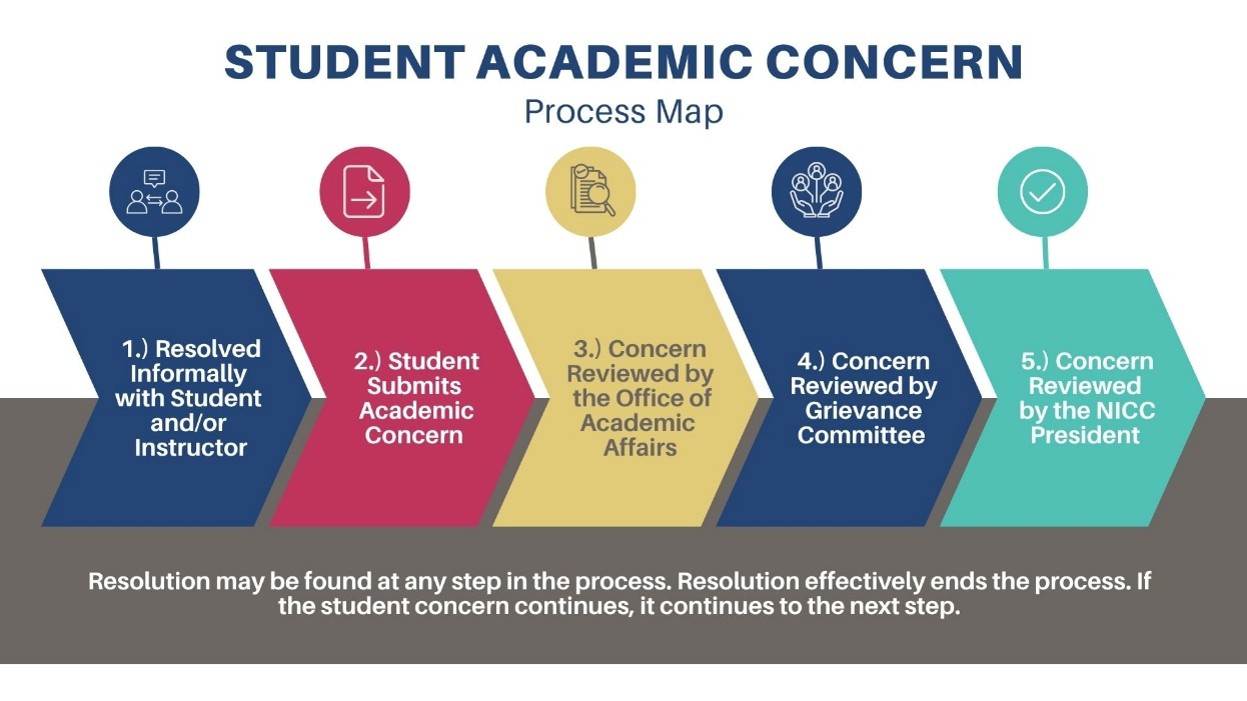
|
Informal Resolution |
Students are strongly encouraged to resolve any concern by communicating directly with the person/department involved and their supervisor if necessary. For the informal resolution stage, preferred communication strategies include meeting in real-time via in-person, virtual or over the phone to discuss the concerns and collaborate on a resolution together. Often these disputes are simple misunderstandings that can be cleared up with an informal meeting. If any party involved is not satisfied with the resolution reached at this meeting or feels too uncomfortable to meet with the other party, an online grievance form should be filed. |
|
Submit Grievance Digital Form |
Every feasible informal means of resolution should be attempted prior to the filing of a grievance form. Student's Academic Concern Form This form is required to file a formal grievance with Nebraska Indian Community College. The grievance form should be submitted within ten (10) calendar days after meeting with the Instructor or Office of Academic Affairs in the informal resolution step. |
|
Review by Office of Academic Affairs |
The electronic grievance form will allow the student to provide details of the current situation, the steps already taken to resolve this grievance, the actions requested towards resolution, and any additional evidence that may be helpful during the investigation. The Office of Academic Affairs will provide written response to the student within ten (10) working days of the date of submission. If the Office of Academic Affairs is unable to obtain a resolution of the grievance, it proceeds to the next step. |
|
Grievance Committee Review |
Within ten (10) working days of the response from the Office of Academic Affairs, a grievance committee meeting will be called. The grievance committee will include minimally, an administrator, a faculty member, and a representative of the NICC student body, all of whom are not reflected as a party of the grievance. The Vice President of Academic Affairs will present the findings. The Committee will meet and review the submitted grievance form with all of the compiled evidence at this meeting, with both parties of the grievance and their advocates. The committee may also meet privately to discuss information presented. Written findings will be issued within three (3) working days of the Committee meeting. If any party remains dissatisfied with the resolution obtained by the committee, they may proceed to the next step. |
|
President Review |
Within three (3) working days of receipt of the Grievance Committee’s findings, any party may request a review by the President. After reviewing the grievance form, evidence, and previous written findings, the President will issue a decision within ten (10) working days of receipt of the request for appeal. |
*Note* If the student has exhausted all resources at NICC, a complaint can be filed with the Nebraska Coordinating Commission for Postsecondary Education at https://ccpe.nebraska.gov/student-complaints-against-postsecondary-institutions .
During fall and spring terms, students who complete the term with a minimum of 6 semester credits with a 3.50 grade point average (GPA) or higher will be recognized by the Dean of Assessment & Curriculum. An official Dean's List will be posted at each college campus and online.
Graduating students who complete their degree programs with a 3.5 - 3.74 cumulative grade point average (CGPA) will be recognized as graduating cum laude. Graduating students who complete their degree programs with a 3.75 - 3.99 cumulative grade point average (CGPA) will be recognized as graduating magna cum laude. Graduating students who complete their degree programs with a 4.00 cumulative grade point average (CGPA) will be recognized as graduating summa cum laude.
Independent study provides sophomore or second level students the opportunity to take a required course that is not included in the regular semester course schedule and will not be scheduled prior to the student’s expected graduation date. The Academic Dean and instructor must approve and have the right to deny the independent study. Independent Study will be outlined by an agreement between the student, the instructor, and the Academic Dean including course requirements and will include registration through the data management system. Not all courses lend themselves to independent study.
An internship is either a paid or un-paid fieldwork experience. A practicum involves practical application of previously studied theory and the collection of data for future theoretical interpretation.
Some departments may require an off-campus placement, clinical, or field experience. Other departments may allow a student to earn academic credit through a specially planned program, usually part-time, supervised by a training sponsor at the work site and coordinated by an NICC instructor. Faculty Advisor and Academic Dean must approve internships. Except with special permission by the faculty, all internships and practica are taken during the sophomore year. An internship contract is completed prior to beginning the internship and an interim and final evaluation conducted by the designated site supervisor is completed and sent to the student's college instructor/coordinator. A maximum of two internships valued at three (3) semester credits each may be taken. Generally, internships require a minimum of 30 hours of on-site experience for each credit; however, requirements vary by program and internship site. If the intern does not accumulate the minimum number of working hours before the end of the academic semester, the instructor may give a grade of “IP”.
A Student may request a Leave of Absence from all courses if s/he needs to be absent for more than two consecutive weeks of class(es). Students may request a Leave of Absence for extreme circumstances. The formal institutional guidelines for this procedure are:
- Students must request the leave of absence in writing, signed and dated, prior to the leave of absence unless unforeseen circumstances prevent the student from doing so. If that is the case, the circumstances must be documented. If the student needs support, they may designate an advocate (after signing the Release of Information form) to assist in this process.
- Documentation supporting the request should be submitted at the same time as the request.
- The written request and documentation should be sent to the Office of the Registrar.
- All faculty members concerned will be provided a copy of the submitted materials for review. This is necessary so that potential problems associated with grading or required assignments can be dealt with. The faculty member may make arrangements to allow the student to complete the coursework that s/he began prior to the leave of absence. The student cannot begin a new semester/term without having completed all conditions of the previously approved leave of absence.
- Faculty members will respond, in writing, to the Office of the Registrar, concerning their agreement or disagreement to the terms of the leave of absence.
- The student and faculty must agree, in writing, with signatures, on the nature of the coursework that must be completed to successfully receive credit for the class. A copy of this agreement should be given to the following: faculty member, student, Dean of Assessment & Currculum, Financial Aid Advisor, Registrar, and Faculty Advisor.
- If all parties agree to the terms of the leave, the leave may be granted. There must be a reasonable expectation that the student will return to school.
- A student may be granted no more than one leave of absence in any 12-month period and it may not exceed 90 days. The institution will not place additional charges on the student’s account for completion of the course work upon return from the leave of absence. An approved leave of absence will not affect a student’s in-school status for the purposes of deferring Federal loans.
- One 30-day extension may be granted due to unforeseen circumstances, such as jury duty, military reasons or circumstances covered under the Family and Medical Leave Act of 1993, these requests will be approved by the Dean of Assessment & Curriculum.
- NICC will try to make the courses available to students upon their return. Some special circumstance may need to be worked out depending on the rotation of the courses of enrollment upon the beginning of the leave.
- If a student does not return from an approved leave of absence, the student’s withdrawal date and the beginning of the student’s grace period for federal loans will be the date the student began the leave of absence. This may exhaust some or all of the student’s grace period for federal loans, putting the student into repayment status.
*In order to totally withdraw, students should follow the Voluntary Withdrawal policy.
If the student disagrees with the Leave of Absence request agreements, please follow the “Student Appeals Process”.
The NICC faculty and administration expects the student to attend all classes and laboratories and be responsible for any work missed due to an absence, regardless of the reason. The instructor, who will state the policy in the course syllabus, determines the attendance policy for each course.
The Office of the Registrar is the official and primary depository of student's permanent academic records. Information concerning grade reports, credits completed, course add/drops, course substitutions, transfer credits, graduation applications, degree audit, programs of study, transcripts, and other academic concerns are located in this office or electronically in the student information system.
The Office of the Registrar is also responsible for collecting and maintaining current and accurate student information such as address, declaration of major, and advisor's name. Much of the information collected is for reporting to the federal government for determination of funding, and for maintaining a mailing list of students' permanent addresses. Personal data such as change of address, change of major, or change of advisor should be reported to the Registrar’s Office as soon as possible.
NICC abides by the principles established by the Family Education Rights and Privacy Act of 2002, Section 507 of Public Law 107-56; as amended April 12, 2002. For more information, contact the Registrar Office.
- IP - In progress: (EX: Internship, practicum, or other course that extends into the next term. Grade will be assigned when responsibilities are completed, refer to full description for more information.)
- W - Voluntary Withdrawal: This grade does not affect the student's GPA; however, financial aid may be affected. See section "WITHDRAWAL" for more detailed information.
- UW - Unofficial Withdrawal: This grade does affect the student's GPA and may put the student on financial aid warning or suspension; EX: Student attended only one day of class and did not officially withdraw. See section "UNOFFICIAL WITHDRAWAL" for more detailed information.
- I - Incomplete: This temporary grade does not affect the student's GPA. See section "INCOMPLETE" for more detailed information.
- P - Pass:This grade option is not calculated into the GPA. Instructors wishing to utilize this option must have approval from the Academic Dean prior to the beginning of registration.(Ex: of use testing out of a class like Intro to Computers)
- R – Repeat: The repeat grade is assigned automatically by the student data management system when a student repeats a course to improve their grade.
- NC - No credit: This grade option is not calculated into the GPA. (See section"AUDITS" for more detailed information)
IN PROGRESS (IP)
In special circumstances, the instructor may issue an “IP” grade when a final grade must be suspended beyond the end of the semester but does not meet the requirements of an incomplete. For example, this may occur with internships, and practica, which extend into the next semester. EX: Internship contact hours not complete.
An “IP” grade does not penalize the student's GPA but is issued until the minimum number of working hours or competencies are completed the subsequent academic semester. After the subsequent semester the grade will revert to an “F”. NOTE: An “IP” will affect the student’s financial aid status. Students will be fully responsible for any financial costs. Please refer to the “FINANCIAL AID: SATISFACTORY PROGRESS” section of this catalog for more information.
VOLUNTARY WITHDRAWL FROM A COURSE (W)
A student may initiate an official withdrawal from a course or courses through the last day of finals after a consultation with the student’s Faculty Advisor. The withdrawal can be initiated by email, official form or phone conversation with STUDENT SUPPORT SERVICES Advisor, or the registrar. Beginning with the Census Date, students will be billed 100% of the tuition charge. Students will be fully responsible for any financial costs. Officially withdrawing from a course(s) does not affect the student's grade point average (GPA). However, it may affect the student's financial aid status due to course completion rate requirements. Refer to the "FINANCIAL AID: SATISFACTORY PROGRESS" section of this catalog for more information.
UNOFFICIAL WITHDRAWAL (UW)
Unofficial Withdrawal (UW) will be the grade assigned in cases of extreme absenteeism.
Excessive Absenteeism is defined as 50% of the course meetings or as a “stop out”
(student has not returned to class at any time for at least two consecutive weeks).
An unofficial withdrawal does affect the student’s grade point average (GPA); and
it may cause the student to be placed on financial aid warning or suspension. The
student may be required to pay for any classes from which he or she has been involuntarily
withdrawn. If a student is involuntarily withdrawn from all classes during two (2)
consecutive semesters, the student will be placed directly on financial aid suspension.
This is a final grade that can be given at any time during a semester.
THE GRADE OF "INCOMPLETE" (I)
Students not able to complete given assignments by the close of the semester in which a course is taken may request an “I” from their instructor. Instructors have the right to approve or deny a request for incomplete. To be eligible for an incomplete, students must have completed at least 50% of their coursework, and submit an official incomplete request form to the instructor.
The Instructor will make a list of the required work that needs to be completed and the date that the work needs to be submitted to be eligible for the changed grade. (All incomplete grades must be resolved by the end of the following semester.)
The "incomplete contracts" must be signed by the student, instructor, and Dean of Assessment & Curriculum, and submitted to Registrar’s Office. The “I” will be posted to the students record upon completion of the contract and its submission to the Registrar. These contracts must be signed and submitted within 10 days of the last day of the term. The grade of “I” will be changed to the earned grade as designated by the instructor on the incomplete contract. Students carrying “I” grades in good academic standing will be eligible for traditional financial aid release dates in the following term. Students carrying “I” grades in probation or warning standing will not be eligible until satisfactory academic progress (SAP) can be determined with the changed grades.
Students receiving a grade of “C” or better may repeat an NICC course one time for Title IV funding as long as they are receiving credit for the course. The grade for the highest grade earned (one grade only) will be used in calculating the student's CGPA, all credits will be used for calculating completion ratio. The lower grade will be changed to a retake “R”. There is no regulatory limit on the number of times that a student may be paid under Title IV to retake a failed course that is needed for program completion.
Nebraska Indian Community College is committed to serving qualified students with disabilities with reasonable accommodation under the Americans with Disabilities Act.
To comply with the mandate of Section 504 of the Rehabilitation Act of 1973, NICC ensures that comparable education programs and services offered to other qualified students are available to qualified students with disabilities. A “qualified student with disabilities” is one who, with reasonable accommodation, can meet all of an education program’s requirements notwithstanding the disability.
Reasonable accommodations are made in the instructional process to ensure appropriate education opportunity. This principle applies to teaching strategies and modes, as well as to institutional policies. It does not mean, however, that essential elements of a course or program will be deleted or substantially altered because of the disability. The objective is to assist the student in meeting established academic standards, not to provide a program different in substance from that provided to other qualified students.
In order for a student to receive disability accommodations under Section 504 of the Rehabilitation Act of 1973, he or she must schedule an individual meeting with their Faculty member before each semester or upon immediate recognition of the disability. It is the student’s responsibility to inform the instructor of the disability and the type of accommodation needed. If the classroom instructor is unable to provide the accommodation, or if the instructor refuses the student’s request, the student may request advocacy services from the Dean of Assessment & Curriculum.
Students with disabilities must provide written documentation from a medical physician and/or licensed clinician that verifies his or her disability with recommended accommodations. Documentation must be current (within 3 years) and will be filed in the student’s permanent record housed at the Macy Campus. Faculty will assist the student in notifying his or her Student Services Advisor about the recommendation for academic accommodation. Disability accommodation plans must be updated EACH SEMESTER.
In the event of a rejection of accommodation request, the student has the right to file a formal grievance by using the protocol currently in place.
More info here: Services for Students with Special Needs
Special Topics courses may be scheduled in any major study area. Special Topics courses have the course number 2900 proceeded by the letter code of the academic discipline. Special Topics courses must be approved through the Academic Council and the Academic Dean prior to the course being offered.
These procedures should be used to appeal or resolve disputes concerning an academic grade or other academic decision considered by a student to be arbitrary or contrary to NICC policy. These procedures should also be used to grieve perceived violations of any of the student academic rights, but not for Unsatisfactory Academic Progress. For the purposes of these procedures, a student is someone holding “active” registration status at the time of the alleged violation. The process is designed to allow for consideration of any new fact or clarification of each particular case. Once a student feels they have resolved their concern they may exit the process. So, for example, if the Dean of Assessment & Curriculum reverses the decision, the student would not have to go to the next step.
Step 1: Informal resolution
A student having a problem with a faculty member or disagreeing with a faculty member's decision should first try to solve the dispute with the faculty member. Often these disputes are simple misunderstandings that can be cleared up with an informal meeting. If a student is not satisfied with the resolution reached at this meeting or feels too uncomfortable to meet with the instructor, he/she should then arrange to meet with the Dean of Assessment & Curriculum and provide evidence that informal resolution was attempted before moving on to the next step of the process. If a student is not satisfied with the informal resolution, he/she/they can proceed to step 2.
Step 2: Office of Academic Affairs Review
The student must file a written appeal with the Office of Academic Affairs within ten (10) calendar days after meeting with the instructor or the Dean of Assessment & Curriculum in the informal resolution step.
The appeal must include the following items:
- Name, address, email, and phone number of the person filing the grievance.
- Explanation of the efforts the student has made to resolve the grievance informally.
- Nature of the grievance in full detail.
- Place, date, and time of alleged incident.
- Name of the person(s) accused of the violation.
- Requested remedy.
- Any background information or documentation the student filing the grievances believes to be relevant.
The Academic Dean will provide written findings to the applicant within ten (10) working days of the date of submission. If the student disagrees with the Academic Dean’s findings, he/she can proceed to Step 3.
Step 3: Scholastic and Appeals Committee Review
Within three (3) working days of an appeal denial by the Dean of Assessment & Curriculum, the student may request a review by the Scholastic and Appeals Committee. The Committee will meet and review the appeal and all documentation and issue a written finding within ten (10) working days of receipt of the appeal. If the student disagrees with the Committee’s findings, he/she can proceed to the final step.
Step 4: President Review
Within three (3) working days of an appeal denial by the Scholastic and Appeals Committee, the student may request a review by the President. After reviewing the appeal and compiled evidence, the President will issue a final decision within ten (10) working days of receipt of the request for appeal. The President’s decision is the final step in the process.
Individual instructors will set their own policy regarding regular student tardiness. However, a student who repeatedly arrives for class late (or repeatedly leaves class early) is not only deprived of valuable course content but is a disruptive influence on other class members as well as the instructor. Disciplinary action may be taken.
For official transcript requests, please view the process and resources at the following link: https://www.thenicc.edu/career-services/transcript-request.php